The Square Kilometre Array Observatory (SKAO), set to be the world’s largest radio telescope, is now under construction. A smaller version of the SKAO, called MeerKAT, has already been constructed and is pioneering radio cosmology and astrophysics. I am a leading member of the cosmology collaborations for both SKAO and MeerKAT.
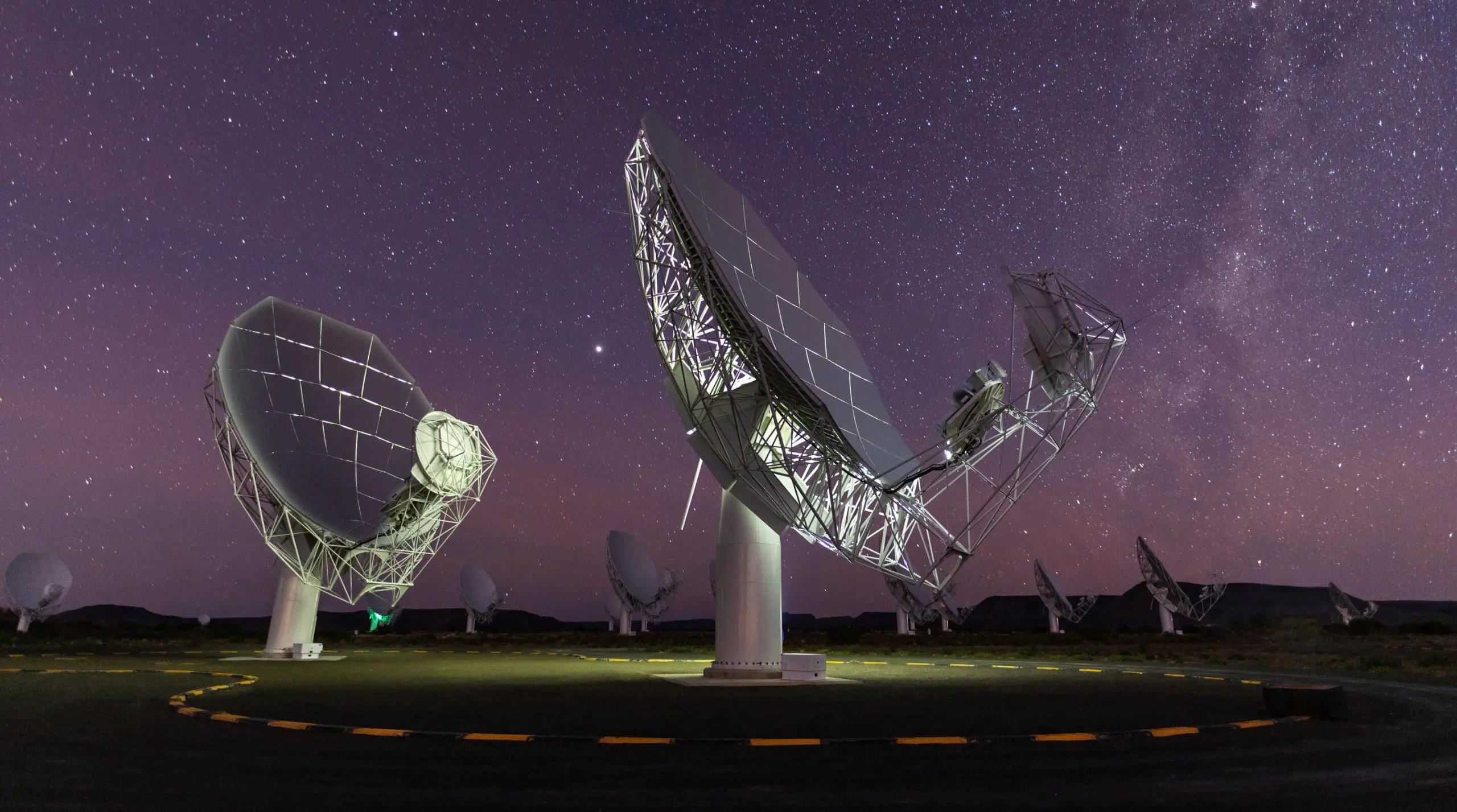
[Credit: sarao.ac.za]
To use these telescopes for my research, the SKAO and MeerKAT need to be operated in unconventional ways. The telescopes are a collection of multiple dishes because they are designed to be used as interferometers, where the dishes are combined as one giant telescope capable of imaging distant objects with high resolution. However, the interferometer will not be sensitive enough to the largest scales most interesting for cosmologists like me. To overcome this problem we instead use the array as a collection of individual telescopes which allows them to map the giant volumes of sky required for cosmology. This mode of observation is referred to as single-dish mode.
I led two pieces of work that demonstrated the potential of using MeerKAT, and eventually the SKAO, in single-dish mode (not as an interferometer).
- My work in this publication revealed for the first time that large sky radio surveys using MeerKAT in single-dish mode, successfully map the structure of the Universe’s cosmic web. The statistical distribution of which is rich in information (see large-scale cosmic structure page).
- My work in this publication proved that we can reconstruct lost signal caused by removing the bright foregrounds from our maps. Bright foregrounds dominate the faint cosmological signal we seek and removing them causes a distortion to the data. Implementing my reconstruction technique corrects for signal loss and allows accurate cosmological analysis.
With the development of the necessary tools, and more data constantly arriving, MeerKAT and SKAO are delivering exciting times for radio cosmologists.
To understand how these telescopes map the Universe, read the next page on 21cm intensity mapping.

 Steven Cunnington